
SWCNT vs MWCNT: Which Carbon Nanotube Type Should You Choose?
Posted by MKnano (division of M K Impex Corp.) on 5th Oct 2026 | Carbon Nanotubes
This guide is a part of our Carbon Nanotube resource hub- product specifications, SDS/TDS, & pack size are on the main product page.
A practical four-step selection guide for researchers, formulators, and technical buyers
Direct Answer
Choose SWCNT if the function relies upon chirality, semiconducting behavior, near-infrared (NIR) optical response, transparency, or development of an efficient network even at very low loads. Select MWCNT if cost, scale, process tolerance, reinforcement and robust conductive network formation are paramount. In each case, identify the complete grade and then test it within your actual formulation.
Single-walled and multi-walled carbon nanotubes have an sp2-carbon framework in common - but they tackle quite different engineering problems themselves. SWCNTs are highly prized whenever there's a need for a very specific electronic or optical response. MWCNTs give you a much wider - and also more tolerant - base for forming conductive, strengthening and supporting networks on an industrial scale.
So the really useful question isn't 'which CNT is best?' but rather 'which performance mechanism will your final formulation be required to deliver - and which material family offers the soundest starting point for your first trial?' This guide starts with function, then moves on to the relevant CNT family - followed by grade specification, dispersion control and finally validation.
Step 1: Define What the CNT Must Do
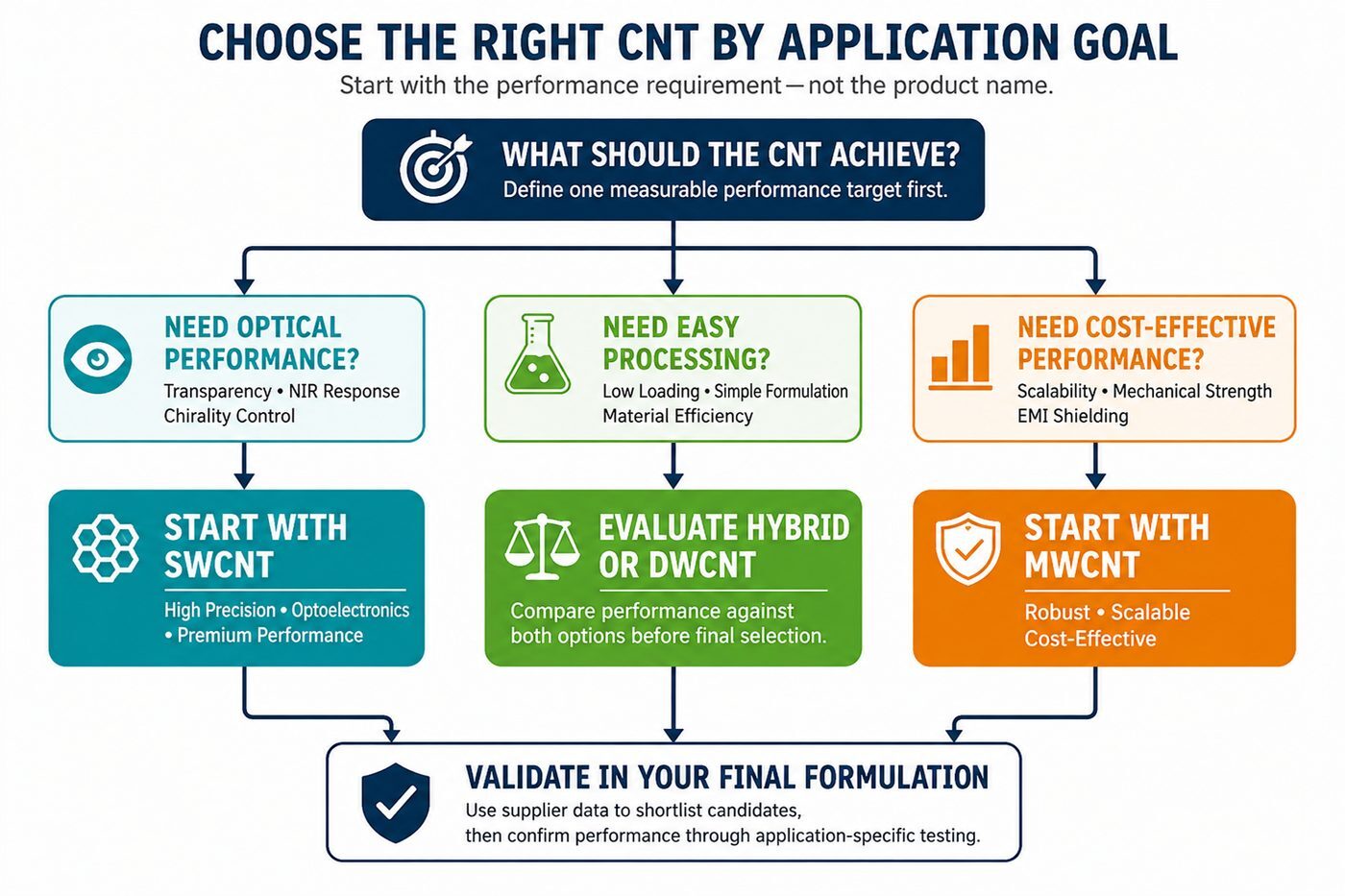
Begin with one quantifiable objective. Do not start out with the greatest possible purity figure, the largest supplier conductivity value, or your most preferred wall number. Your starting point will be more defensible when it's based on the function that has to show up in your final product - whether that's a device, film, slurry, polymer, or composite material itself.
Step 2: Understand the SWCNT vs MWCNT Difference That Affects Your Choice
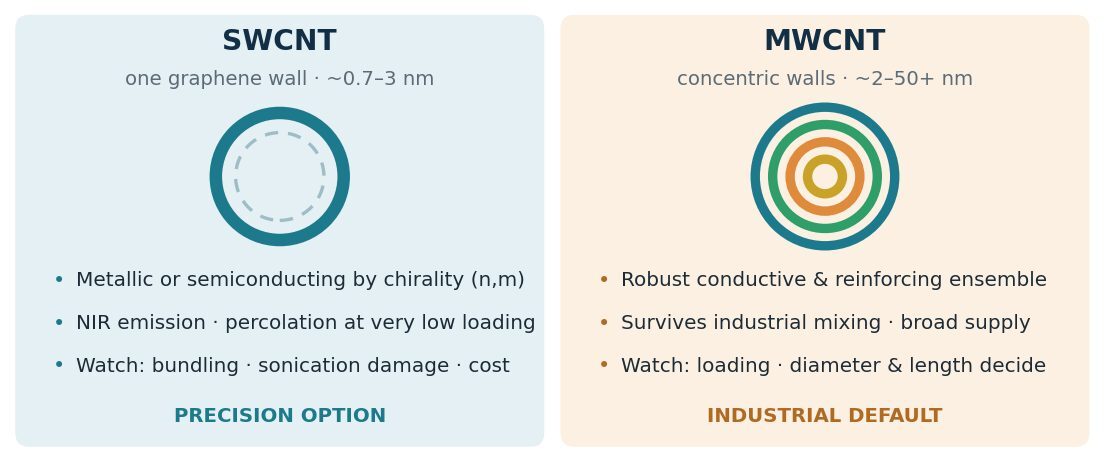
An SWCNT is a single rolled-up graphene cylinder itself. Its chiral indices will determine if it acts like a metal or a semiconductor nanotube - this is why sorted or enriched SWCNTs are so important for the channels of transistors, transparent electrodes, and also infrared light sensors. An MWCNT has several concentric layers of a graphene wall and is usually chosen as a conductive, reinforcing, or supporting material itself rather than being considered an electronically addressable material based on its chirality.
| Selection factor | SWCNT | MWCNT | Why it matters |
|---|---|---|---|
| Wall structure | One graphene cylinder | Multiple concentric cylinders | Changes tunability, defect sensitivity and tolerance |
| Electronic behaviour | Metallic or semiconducting by chirality | Mixed conductive ensemble | Only SWCNT supports clean electronic-type selection |
| Optical behaviour | Chirality-resolved absorption and NIR response in suitable grades | Broader response; not cleanly chirality-addressable | SWCNT leads optical and photonic uses |
| Processing tolerance | Narrower; length and defects need careful control | Generally broader for industrial mixing | Affects scale-up risk |
| Sourcing default | Specialist and grade-dependent | Broad industrial availability | Affects qualification and dual sourcing |
| Common applications | Devices, sensors, transparent films, premium networks | Batteries, polymers, rubber, composites and shielding | Match the family to the bottleneck |
Rate the CNT Types Against Your Priority
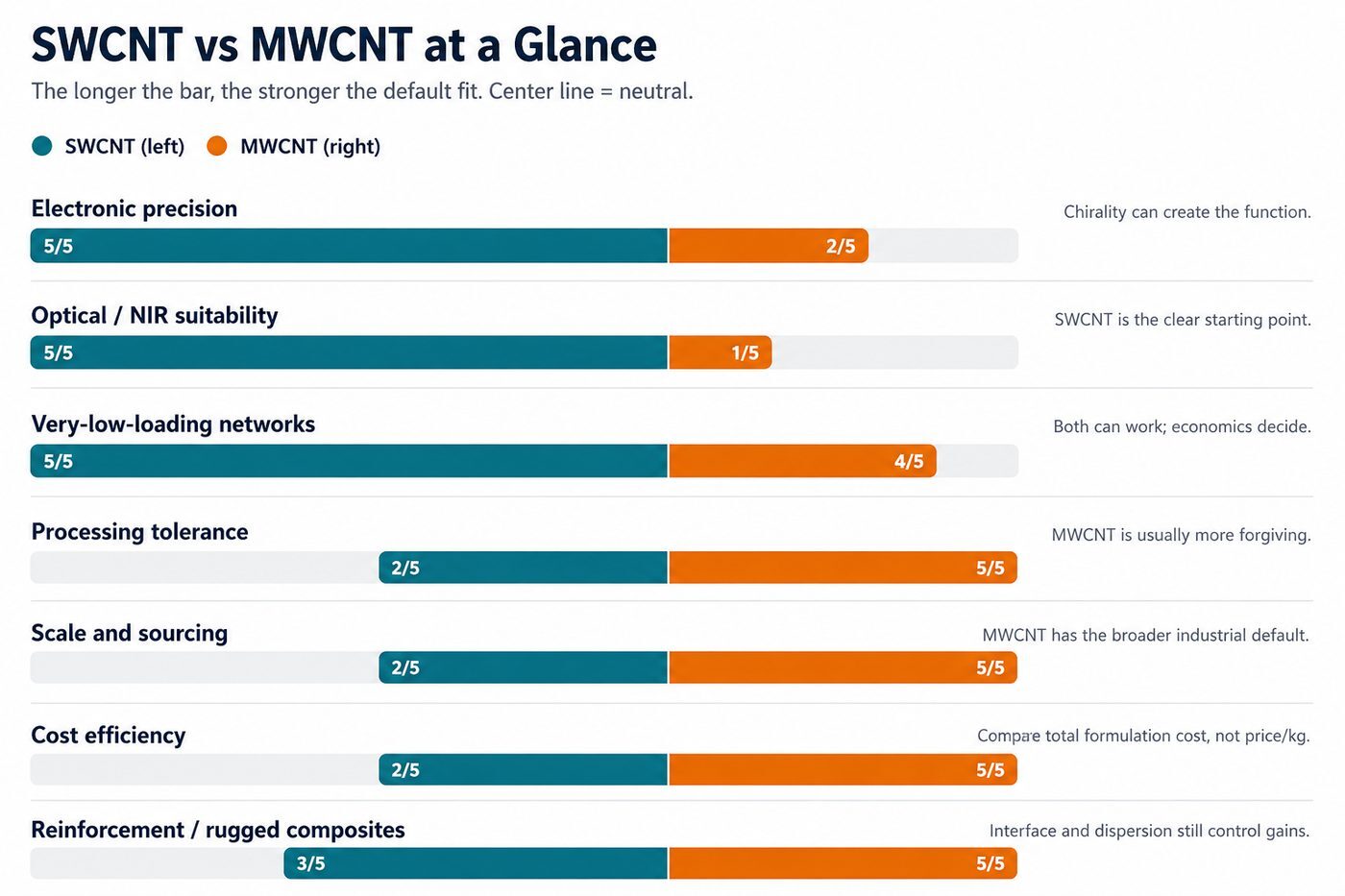
These ratings will be starting-point indicators - not universal rankings for materials themselves. They'll reveal which family will normally be more easily justifiable as the very first candidate under evaluation for every particular requirement.
Step 3: Choose the CNT Material by Application
Make use of the application shortcut provided below only after you have set up your performance mechanism. 'Start with' signifies the very first reasonable test - one that is a good starting point, though it doesn't necessarily mean this will be the final winning formulation.
| Application | Start with | Switch or expand the screen when |
|---|---|---|
| Li-ion conductive additive | MWCNT | SWCNT or a hybrid network when very low loading increases active-material fraction |
| Silicon-anode network | SWCNT / hybrid | MWCNT when slurry handling, viscosity and process robustness dominate |
| Conductive / ESD plastics | MWCNT | SWCNT when strict loading, transparency or premium multifunctionality justifies tighter control |
| EMI shielding, rubber and composites | MWCNT | SWCNT for ultralight premium films or very low loading |
| Transparent conductive films | SWCNT | MWCNT only when the optical-loss trade-off remains acceptable |
| Transistors/semiconductors | Sorted SWCNT | There is no generic MWCNT substitute for semiconductor-type selection |
| NIR optical sensing | Semiconducting SWCNT | Select by chirality distribution and optical response |
| Catalyst supports / membranes | Functionalized MWCNT | SWCNT for high-surface-area or specialised research targets |
| Electrochemical sensors | Application-dependent | Choose electronic precision versus a rugged functionalized surface |
APPLICATION RULE
Application name narrows down your search, but the method will decide on the very first material itself. For instance, "battery" doesn't necessarily mean one specific type of tube - a production-oriented conductive network might start with MWCNT. In contrast, a silicon-rich electrode which has to keep inactive additives to a minimum could well be made from SWCNT or a hybrid network.
Step 4: Specify the Complete CNT Grade
Commercial customers don't buy "a CNT" for its own sake. Instead, they pick out a specific bundle that's determined by the number of walls, the degree of purity, any remaining catalyst, the diameter, the length, the level of defects, the surface chemistry itself - and also the format in which it will be delivered. Every parameter should be linked with a quantifiable risk of failure or a specific performance goal.
Figure 3. A useful RFQ narrows from material family to dimensions, chemistry, delivery format and process evidence.
| Specify this | Why it matters |
|---|---|
| Purity and residual-metal limits | Catalyst and carbonaceous residues can distort electrochemistry, optics and sensitive analysis. |
| Diameter and length distribution | These affect surface area, curvature, aspect ratio, network formation, viscosity and reinforcement. |
| Pristine, graphitized or functionalized surface | Pristine or graphitized grades preserve transport; functional groups can improve wetting, bonding or anchoring. |
| Powder, aqueous/solvent dispersion, masterbatch or film | A process-ready format can reduce dust handling and shorten formulation development. |
| Required QC documents | Raman, TGA, microscopy, elemental/surface analysis and formulation tests answer different questions. |
Control Dispersion Before Judging Performance
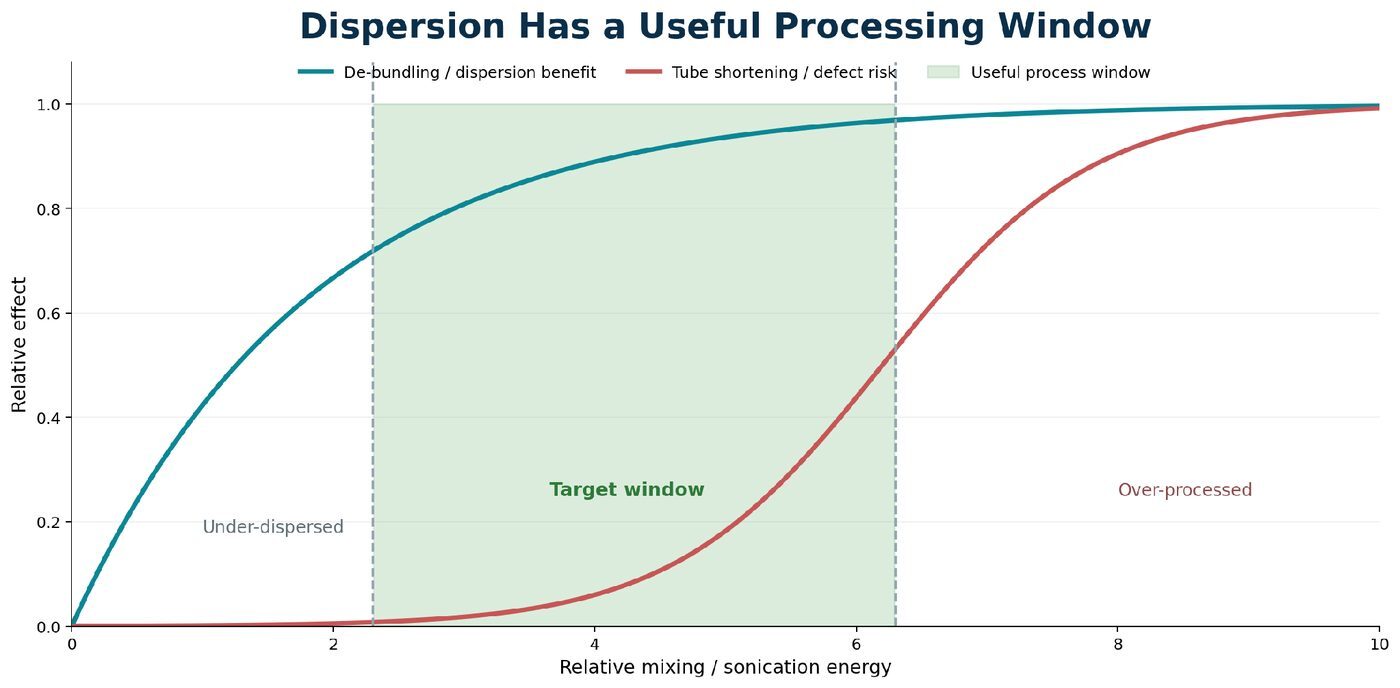
CNT bundles form themselves because of their very high aspect ratio and van der Waals attraction. Mixing and sonication will help de-bundle them, but too much energy can both shorten tubes and also increase defects.
The actual processing window really lies between a network that's underdispersed and one that's been over-processed. This window is quite narrow itself but even more so for SWCNTs.
PRACTICAL RULE
Choose functionalised CNTs if wetting, matrix bonding, catalyst anchoring or dispersion stability is your main problem. Choose pristine or graphitised grades when electrical, thermal or optical transport is your major problem.
Using a pre-dispersed product may cost you more per kilogram, but it will cut down on your development time, powder handling, and also reduce the number of batches that fail.
Validate the Carbon Nanotube In Four Practical Stages
| Stage | Record | Pass criterion |
|---|---|---|
| 1. Incoming material | Exact grade, batch, COA/SDS, dimensions, purity and surface treatment | Documentation matches the RFQ and intended mechanism |
| 2. Dispersion | Solvent/binder, solids, mixing method, delivered energy, time and stability | No unacceptable sedimentation, agglomeration or viscosity rise |
| 3. Application test | Loading, conductivity, mechanical/thermal result and process behaviour | The target is reached without an unacceptable cost or processing penalty |
| 4. Repeatability | At least one repeat and, for scale-up, another batch | Performance remains inside the project acceptance window |
One single purity percentage isn't sufficient. Raman spectroscopy will tell you about graphitic order and defects themselves; microscopy will then confirm your morphology and wall structure; TGA will back up an assessment of impurities; UV-Vis-NIR or photoluminescence is pertinent to sorted SWCNTs themselves; while rheology and application conductivity show if the material you've bought actually does work within the process that matters most.
Five CNT Selection Mistakes and Faster Fixes
- Selecting by wall count aloneWrite a complete grade specification.
- Comparing ideal tube properties with a composite targetMeasure the actual film, slurry or composite.
- Using excessive sonicationControl delivered energy and monitor tube damage.
- Buying powder when the process needs a stable liquidScreen compatible dispersions or masterbatches early.
- Assuming lower loading always means lower costCompare total formulation and qualification cost.
Safety and Responsible Handling
HANDLE THE FORM, NOT ONLY THE CHEMISTRY
CNT exposure risk will depend upon morphology, dimensions, agglomeration state, surface treatment, exposure route and lifecycle stage. Avoid uncontrolled airborne powder itself - use an enclosure or local exhaust when feasible - be guided by the SDS and carry out a task-specific risk assessment - and apply some extra controls whilst transferring powder, milling, sonicating or drying it.
The NIOSH suggests a respirable elemental-carbon exposure limit of one microgram per cubic meter as an 8-hour TWA for CNT/CNF work - this is a recommended occupational limit, not a universally binding legal limit.
Which MKnano CNT Category Should You Review?
MKnano’s carbon nanotubes platform aids your selection process by distinguishing between single-wall, multi-wall and dispersion pathways. Review SWCNT categories for semiconducting, metallic/conducting, ultra-pure, functionalized or length-controlled requirements.
Review MWCNT categories when the principal screening parameters are diameter, length, graphitization, functionalisation and industrial availability. Review CNT dispersions if compatibility, dust handling or formulation speed are your immediate bottlenecks.
Final Recommendation: Select the Constraint, Not the Superlative
Final Verdict
SWCNT will be your best choice rationally if chirality, semiconducting behavior, near-infrared (NIR) optics, transparency, or an extremely low load will create the required value. MWCNT will be your best choice rationally if cost, scale, mixing tolerance, reinforcement and supply resilience are what matter most.
In each case, the final decision really needs to say how pure it should be, what its dimensions should be, what residues there should be, what its surface chemistry should be and what format it should have - and all that has to be checked out in the actual formulation itself.
Tell MKnano about your intended application, matrix, load range, mixing method and desired performance so that they can determine some likely starting points - such as SWCNT, MWCNT or DWCNT - or a dispersion that you should evaluate.
Frequently Asked Questions
Q. Is SWCNT always more conductive than MWCNT?
A. No. An individual metallic SWCNT will transport exceptionally well itself, but the conductivity of a product will depend on tube contacts, dispersion, length, loading and alignment. SWCNTs are chosen for electronic precision or highly efficient low-loading networks whilst MWCNTs frequently provide the more practically oriented industrial network.
Q. Which CNT is better for polymer composites?
A. MWCNTs are typically the initial materials to consider because they are widely available and far more tolerant of industrial mixing processes. Think about using SWCNTs if an extremely low loading, transparency, or a high-value multifunctional response justifies additional expense and control over your manufacturing process.
Q. Should batteries use SWCNT or MWCNT?
A. MWCNTs represent a standard production-driven starting point. SWCNT or hybrid networks themselves could be really valuable if you need a lower conductive additive loading so as to increase the fraction of your active material or support demanding silicon-anode structures.
Q. When should functionalized CNTs be used?
A. Make use of these when wetting, dispersion stability, interfacial bonding, or catalyst anchoring forms the bottleneck in your application. Ensure that any treatment does not eliminate the necessary electrical, thermal, or optical properties of the material.
Sources and Technical References
- MKnano Carbon Nanotubes hub
- MKnano Multi-Walled Carbon Nanotubes category
- MKnano CNT Dispersions category
- NIOSH Current Intelligence Bulletin 65: Occupational Exposure to Carbon Nanotubes and Nanofibers
- Irita, Yamamoto & Homma (2021), chirality distributions for semiconducting SWCNTs
- Maeda et al. (2011), transparent and conductive SWCNT thin films
- Sonochemical modification of carbon nanotubes: shortening and defect risk at excessive ultrasound exposure
- Optimized dispersion quality of aqueous carbon nanotube colloids
| Technical Notice: We provide general technical information, not application-specific engineering or safety advice. Results depend on product grade, materials, methods and operating conditions. Review the current SDS, TDS and product instructions, and independently test and confirm suitability before use. [Read the full Technical Information Disclaimer.] |