
Graphene Grade Selector: Find the Right Graphene for Your Application
Posted by MKnano (division of M K Impex Corp.) on 8th Oct 2026 | Graphene
This page is a part of Mknano’s graphene resource hub. Confirm product specifications, current SDS/TDS availability, lead time, and pack sizes for the exact SKU before placing an order.
Not sure which graphene to order for your application? Answer three questions in the selection below or read the plain-language guide. It includes which grade is right for which job, the meaning of the technical terms, and what to check before you order.
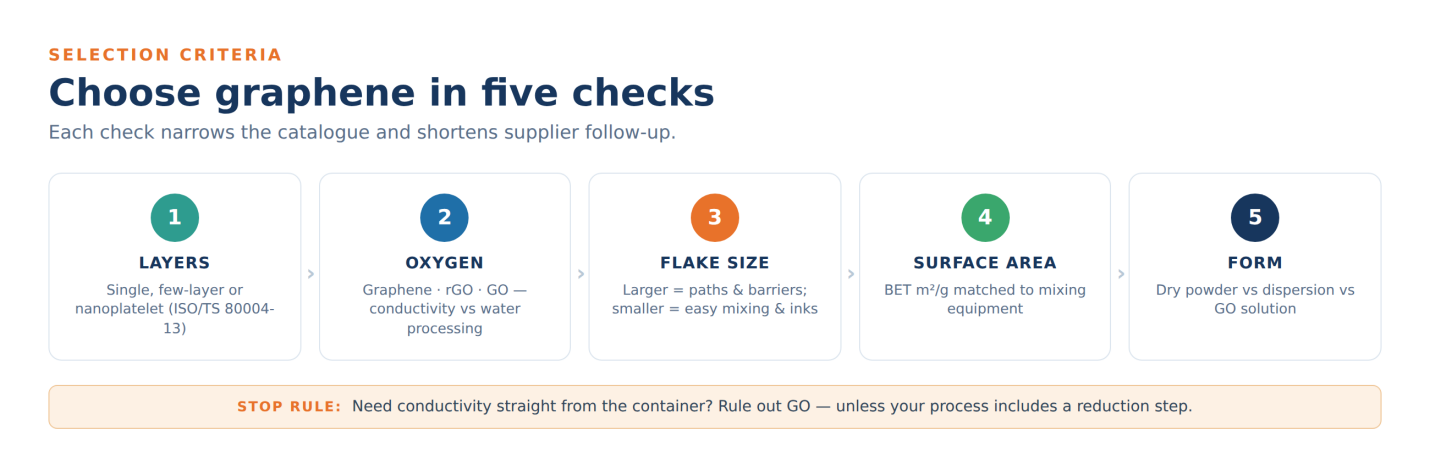
To choose the right graphene grade, match five things to your application: layer count (single-layer, few-layer, or nanoplatelet), oxygen content (graphene, GO, or rGO), flake size, form (dry powder or water-based liquid), and your process (dry/melt or wet).
Interactive Graphene Grade Selector
Why Graphene Grade Selection is Important?
The following four facts decide whether the graphene project works:
Comparison of Graphene Grades - GNP vs Single-layer vs Go vs rGO
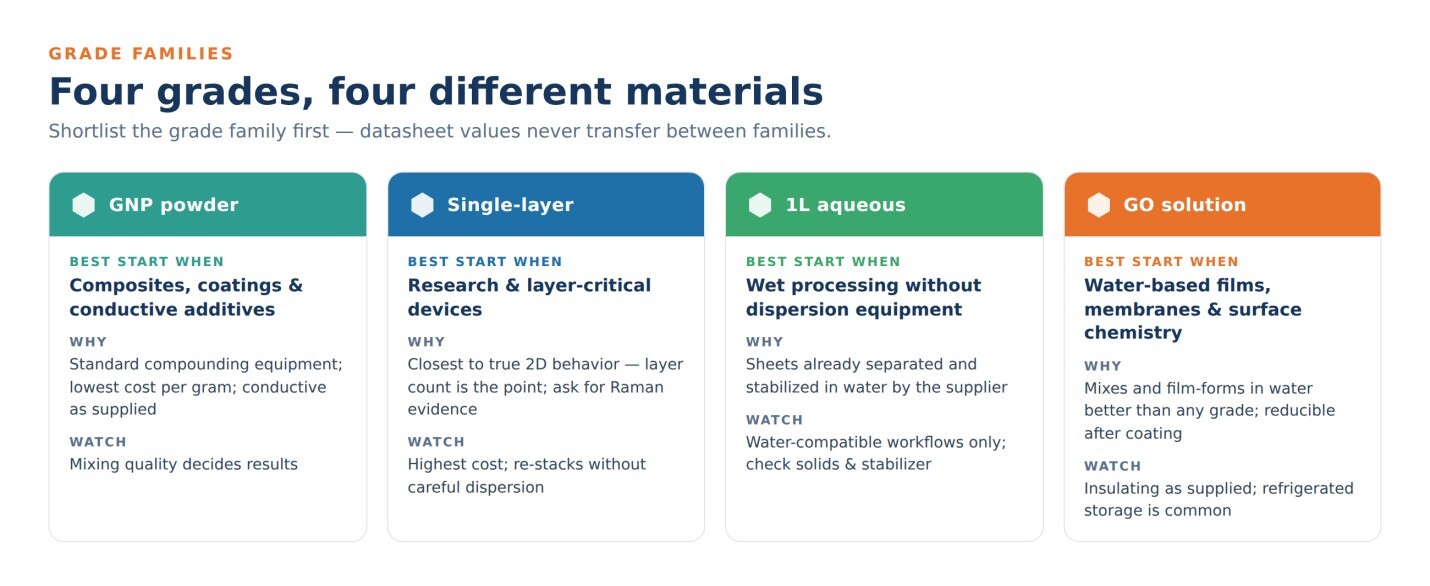
Four different names are four different materials which are compared based on what matters for selection.
| Grade | What it is | Conducts electricity? | Best suited to | The trade-off |
|---|---|---|---|---|
| Graphene nanoplatelets (GNP) | Stacks of graphene sheets, a few nanometres thick, up to micrometres wide | Yes | Composites, coatings, conductive additives at industrial scale | Behaves like a very thin flake material, not single-sheet graphene |
| Single-layer graphene | One carbon sheet, one atom thick | Yes | Research and layer-critical applications | Highest cost; re-stacks if handled carelessly |
| Graphene oxide (GO) | Graphene with many oxygen groups attached; usually sold in solution | No — not until reduced | Water-based films, membranes, coatings, surface chemistry | Needs a conversion step for conductivity; refrigerated storage is common |
| Reduced graphene oxide (rGO) | GO after most oxygen is removed | Partly — varies by product | Conductive coatings and electrodes via the water-based route | Performance depends heavily on the reduction method — compare data |
READING GRAPHENE DATASHEETS: Lab records vs product performance — Graphene’s famous facts - ‘200 x stronger than steel ’ and ‘Extremely high thermal conductivity’ were measured on a perfect single sheet under lab conditions. The figures describe the material’s potential and not the performance of a commercial product or solution. Compare grades based on measured lot data and test a small sample in your application before scaling up.
Graphene Application Guide: Which Graphene Grade Should I Choose?
Always confirm the final product choice by using a small trial sample in your application.
| Your application | Start with | Why this grade fits | Watch out for |
|---|---|---|---|
| Plastics, rubber & composite parts | GNP | Runs through standard compounding equipment; a few percent by weight is the typical literature starting loading; lowest cost per gram | Results live or die on mixing quality |
| Conductive parts, electrodes, EMI shielding, anti-static | GNP or rGO | Both conduct as supplied; well-chosen flakes form a conductive network at low added amounts | rGO conductivity varies — compare measured numbers, not the name |
| Water-based coatings, films & membranes | GO solution | Mixes and forms films in water more easily than any other grade; can be reduced after coating | Insulating as supplied; store as directed (refrigeration is common) |
| Conductive inks & printed electronics | Small-flake GNP or rGO | Smaller flakes disperse evenly and pass fine nozzles; GO-then-reduce is a common printing route | Match flake size to the printing method |
| Research where layer count matters | Single-layer graphene | Closest to true one-sheet behavior — the layer count is the point | Highest cost; re-stacks without careful dispersion |
| Liquid processing without dispersion equipment | Single-layer in aqueous solution | The supplier has already separated the sheets and stabilized them in water | Water-compatible workflows only; check solids content and stabilizer |
| Sensors & functional surfaces | GO solution or 1L dispersion | GO's oxygen groups give attachment chemistry; liquids coat evenly | Surface chemistry varies by lot — request the COA |
How to Choose Graphene: Top 5 Graphene Selection Criteria
STANDARD = from an official ISO/ASTM document · LITERATURE = general published science. Confirm against the specific product's COA/TDS.
| Key criteria | In Other Words | Quick Selection Rule |
|---|---|---|
| 1. Layer count [STANDARD] | How many carbon sheets are stacked. ISO/TS 80004-13:2024 treats up to ~10 layers as a 2D material; thicker stacks are nanoplatelets. | Composites and coatings rarely need single-layer; devices and 2D research do — with Raman evidence. |
| 2. Oxygen content [LITERATURE] | More oxygen = easier water mixing and richer chemistry, less conductivity. Measured by XPS as the C:O ratio. | Need conductivity out of the container? Avoid GO — unless your process includes a reduction step. |
| 3. Flake size [LITERATURE] | Larger flakes build longer conductive paths and better barriers; smaller flakes mix more easily. | Barriers & EMI → larger flakes. Inks & thin coatings → smaller flakes. |
| 4. Surface area (BET) [STANDARD] | Surface per gram (m²/g). Higher usually means thinner stacks and more matrix contact. | Match to your mixing equipment — very high surface area demands more energy and dispersant. |
| 5. Form [LITERATURE] | Dry powder, water-based dispersion, or GO solution. | Dry/melt process → powder. Wet process → dispersion or GO solution. |
Graphene Powder vs Dispersion: Which Form Should I Choose?
| Form Type | Best Suited For | What Do You Handle | Look For |
|---|---|---|---|
| Dry powder (GNP, single-layer) | Melt compounding, masterbatch, dry blending | The entire mixing/dispersion step | Fine-powder handling controls per the SDS; clumping if under-mixed |
| Water-based dispersion (single-layer) | Coatings, films, wet formulation | Formulation compatibility only — exfoliation is done | Solids content, stabilizer system, water-compatible workflows only |
| GO solution | Water-based films, membranes, layer-by-layer coating | Optional reduction step if conductivity is needed | Insulating as supplied; refrigerated storage is common — check the TDS shelf life |
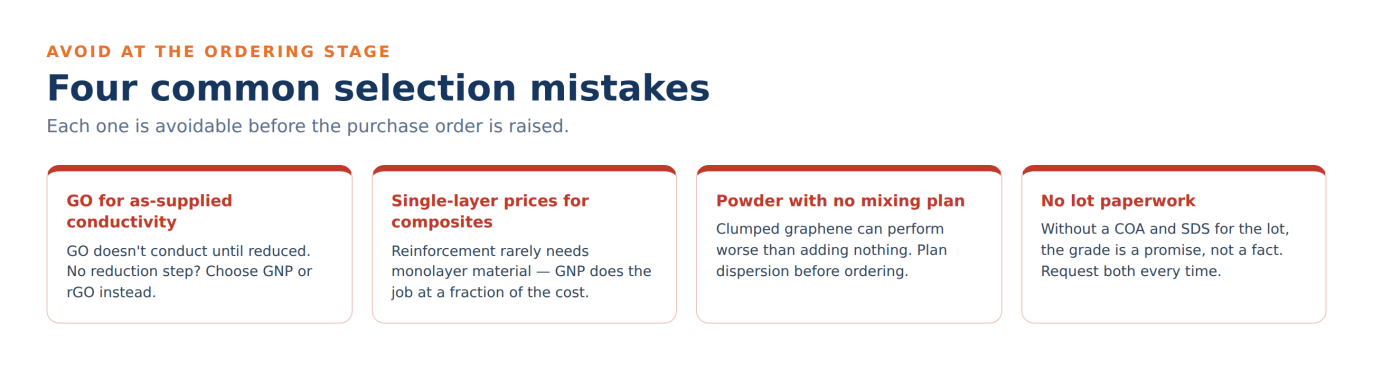
Most Common Graphene Selection Mistakes
Quick Graphene Selection Checklist
The seven selection checks that can turn a vague inquiry into a comparable quote are as follows:
GATE: Scale up only after the trial lot passes your application test ? same grade, same documentation.
How To Compare Different Graphene Grades? Verification & COA Checks
The buyers need not do any of the tests; they only need to go through a Certificate of Analysis (COA) and compare suppliers on the same level.
| Type Of Lab Test | In Other Words | What To Check In A COA |
|---|---|---|
| Raman spectroscopy | A laser test that reads the carbon's “fingerprint” — defect level and layer character | D band (~1350 cm⁻¹, defects), G band (~1580 cm⁻¹, healthy carbon), 2D band (~2700 cm⁻¹, layer character). Lower D-to-G generally means fewer defects. |
| XPS | Measures oxygen content | The carbon-to-oxygen (C:O) ratio — the key number for GO and rGO comparisons. |
| SEM / TEM | Electron-microscope photos of the actual flakes | Flake width, clumping; representative images with scale bars, not one best shot. |
| BET | Measures surface area per gram | The m²/g value on the powder as supplied. |
The three reference documents that give the industry a common language - ISO/TS 80004-13:2024 (official graphene naming), ISO/TS 21356- 1:2021 (characterising graphene form powders and liquids) and ASTM E3220-20 (characterising graphene flakes by Raman, XPS and AFM). Request SDS and COA for your specific lot and keep them with your batch records.
Buying Graphene in the US & Canada: Regulations
In the United States, an EPA rule under TSCA regarding certain graphene nanoplatelets was finalized and became effective on September 29, 2025. The rule was designated as ‘Significant new uses’ and requires a notice 90 days in advance.
In Canada, graphene has been assessed under CEPA’s new-substances process (graphene-specific registry number CAS 1034343-98-0) with conditions on significant new activities. Routine research purchases are generally considered straightforward, but commercial users have to confirm their obligation with the relevant authority.
SAFETY AND HANDLING NOTE:
Treat dry graphene powders as fine nanomaterial powders. Use the protective equipment and ventilation controls specified in the product SDS. Review the SDS for the specific product and lot before use. This article is a selection starting point and not a product-specific EHS review.
Graphene Product Selector At MKnano
| MKnano Category | Graphene Grade family | Typical Starting Point For |
|---|---|---|
| Graphene Nanopowder & Graphene Nanoplatelets | GNP powder | Composites, coatings, conductive additives, industrial formulation |
| Single Layer Graphene | 1-layer powder | Research and layer-critical applications |
| Single Layer Graphene in Aqueous Solution | 1-layer in water | Liquid processing without in-house dispersion equipment |
| Single Layer Graphene Oxide in Solution | GO solution | Water-based coatings, films, membranes, surface chemistry |
The Certificate of Analysis (COA) and SDS are available on request for specific lots and products. Mknano is a division of M K Impex Corp. (Mississauga, Ontario). It ships from Canada to industrial and research customers in 35+ countries.
Frequently Asked Questions
Q. Which Graphene is best for composites?
A. Usually, GNP is the starting point, processed with standard compounding equipment, with the lowest cost per gram and a few per cent by weight at typical literature starting loading. Results depend on the mixing quality. Confirm with a small trial sample in your formulation. No single grade is best for a composite system.
Q. Which graphene is used in batteries?
A. Most conductive additives are GNP or rGO. They are chosen based on the conductivity, surface area and slurry compatibility. GO is perfect for workflows that process in water and reduce afterwards. Test a small trial sample in your electrode formulation before buying.
Q. Which graphene is used in coatings?
A. For water-based coatings, films and membranes, use the GO solution (it can be reduced in application if conductivity is needed). For powder and solvent-borne systems which need conductivity as-supplied, use GNP. Match the flake size to film thickness and finish.
Q. Which graphene grade is used in research?
A. For layer count or 2D behaviour use single-layer graphene (powder or aqueous solution without dispersion equipment), which is supported by Raman evidence for the lot. For applied composites/coatings research, the grade (GNP or GO) that matches the end application is more relevant and economical.
Not sure which grade fits your application?
Share the application, process (dry or liquid) and quantity — the MKnano technical team can point you to the right category. SDS and COA available on request for specific products and lots.
Technical source notes
Supplier-facing specifications should be confirmed against current product documentation before publication or purchase. Research findings and standards describe measurement approaches; they do not guarantee application performance.
MKnano Graphene hub and listed product categories — https://mknano.com/graphene-fullerenes/graphene/
ISO/TS 80004-13:2024 — Nanotechnologies — Vocabulary — Part 13: Graphene and related two-dimensional materials
ISO/TS 21356-1:2021 — Structural characterization of graphene from powders and dispersions
ASTM E3220-20 — Standard Guide for Characterization of Graphene Flakes (Raman, XPS, AFM)
Kauling, A. et al., “The Worldwide Graphene Flake Production,” Advanced Materials 2018, 30, 1803784 — DOI 10.1002/adma.201803784 (historical context on commercial layer-count variability)
US EPA — TSCA Significant New Use Rule for certain graphene nanoplatelets (effective Sept 29, 2025)
Environment and Climate Change Canada / Health Canada — CEPA New Substances provisions for graphene (CAS 1034343-98-0; the CAS on individual product SDS documents may differ by product form)
| Technical Notice: We provide general technical information, not application-specific engineering or safety advice. Results depend on product grade, materials, methods and operating conditions. Review the current SDS, TDS and product instructions, and independently test and confirm suitability before use. [Read the full Technical Information Disclaimer.] |