
How to Buy Graphene: RFQ, Grade & Documentation Guide
Posted by MKnano (division of M K Impex Corp.) on 7th Oct 2026 | Graphene
This guide forms part of MKnano's Graphene resource hub. Product-specific details, current SDS or TDS availability, pack sizes and lead times should all be checked for your exact SKU before you place an order.
Purchasing graphene isn't quite like buying a single product itself. Commercially available 'graphene' could be referring to graphene nanoplatelets (GNPs), layer-controlled flakes, graphene oxide (GO) or its reduced form (rGO), a functionalised material, a powder, a dispersion or a supported film. These forms aren't all equivalent to one another. A dependable purchase will start with determining your needs for the function, process and evidence required - and then request each supplier to provide a quote for the exact same form, grade, quantity and documentation bundle.
Direct Answer
To purchase graphene, first select the material family and delivery form that will be compatible with your process requirements. Then establish your critical dimensions and chemistry requirements, request the relevant SDS, TDS or specification sheet, lot-COA process details and characterization data - and also qualify a representative sample. Don't review quotes until all the suppliers are providing quotes based on the exact same material definition and the full scope of your order.
1. Start With The Form Your Process Can Use
That very first purchasing decision isn't actually the supplier - it's the material family. ISO terminology will help differentiate between graphene itself and related materials; however, your procurement documents have to say even more about the form in which it's supplied, its dimensions, its chemistry, and also your measurement methods. If a buyer simply asks for 'graphene ', they're leaving far too many variables undefined.
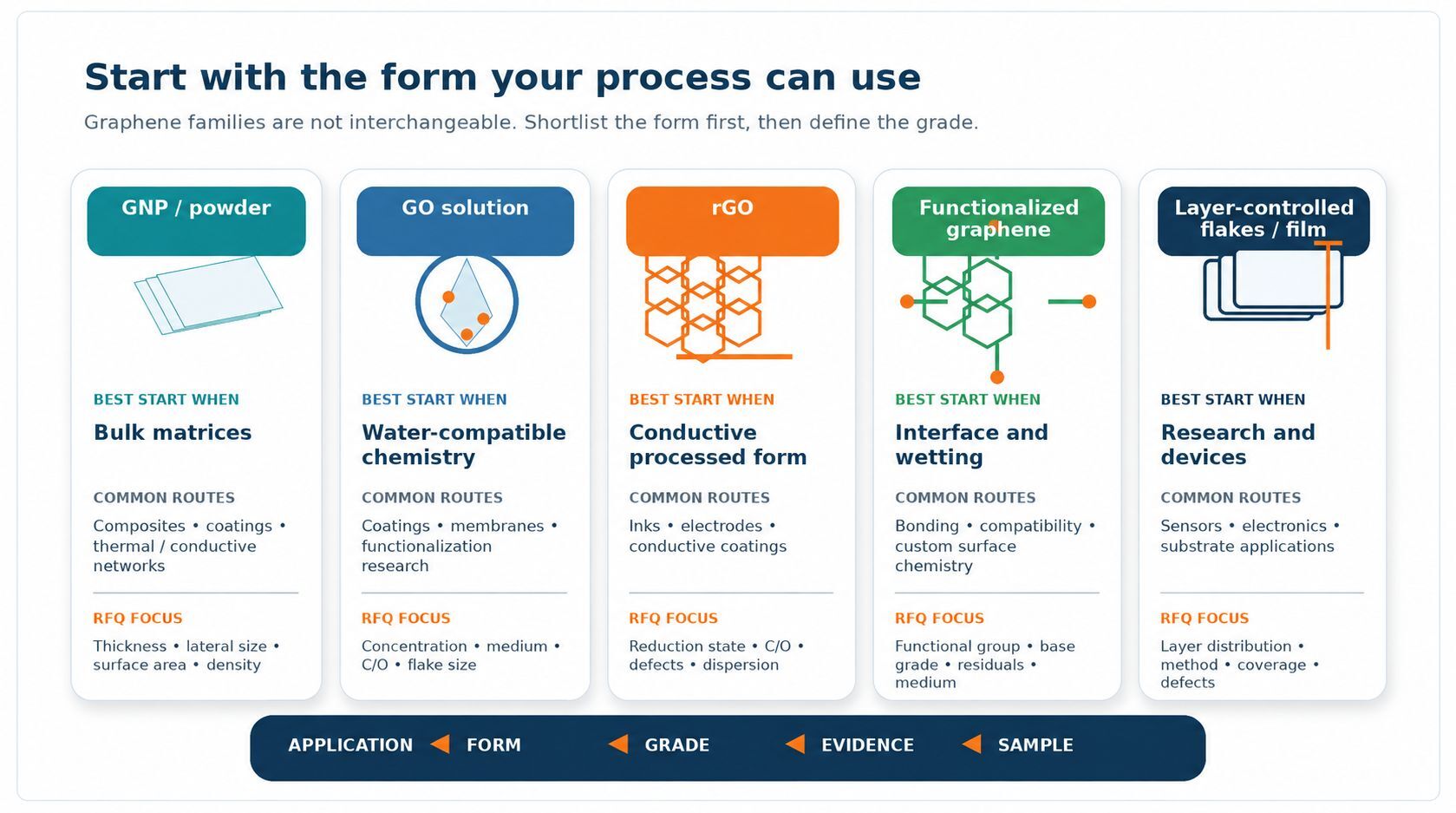
| Material family | Common buying reason | Typical delivery | RFQ fields to prioritize | Key caution |
|---|---|---|---|---|
| Graphene nanoplatelets/nanopowder | Bulk matrices, conductive or thermal networks, reinforcement | Powder, masterbatch or dispersion | Thickness or layer distribution; lateral size; surface area; bulk density; carbon, oxygen and residues | The final outcome can be dominated by agglomeration, mixing and matrix compatibility. |
| Graphene oxide (GO) | Water-compatible chemistry, coatings, membranes and functionalization research | Aqueous dispersion or powder | Concentration and medium; carbon-to-oxygen or oxygen content; flake size; pH or stabiliser where relevant | GO is both chemically and electrically very different from its reduced or pristine forms. |
| Reduced graphene oxide (rGO) | Conductive inks, coatings, electrodes and solution-processed networks | Powder or dispersion | Reduction state; carbon-to-oxygen ratio; defects; flake size; medium and concentration | Reduction and dispersion routes will alter your conductivity and batch behavior. |
| Functionalized graphene | Wetting, bonding, matrix compatibility or a specific surface interaction | Powder or dispersion | Functional group; degree or method of treatment; base material; residual reagents; medium | Surface treatment could improve compatibility but will also change transport levels or defects themselves. |
| Layer-controlled graphene flakes | Research, sensing and applications where the distribution of layers matters | Powder or dispersion | Layer or thickness distribution and measurement method; lateral size; defects; purity | Dry flakes will naturally restack themselves. Any claims about having just one layer really need supporting characterisation data. |
| CVD or supported graphene film | Substrate and device applications | Film on a named substrate | Coverage; layer uniformity; sheet resistance; substrate; transfer method; usable area | Film quotes are usually based on area and the substrate used - not comparable to a powder on a per-gram basis itself. |
BUYER CHECK: A supplier's family name itself is just the beginning. Be sure to ask about the specific grade code and provide proof for each claim made about layer, size, chemistry, and purity.
2. Choose The Grade By The Performance Mechanism
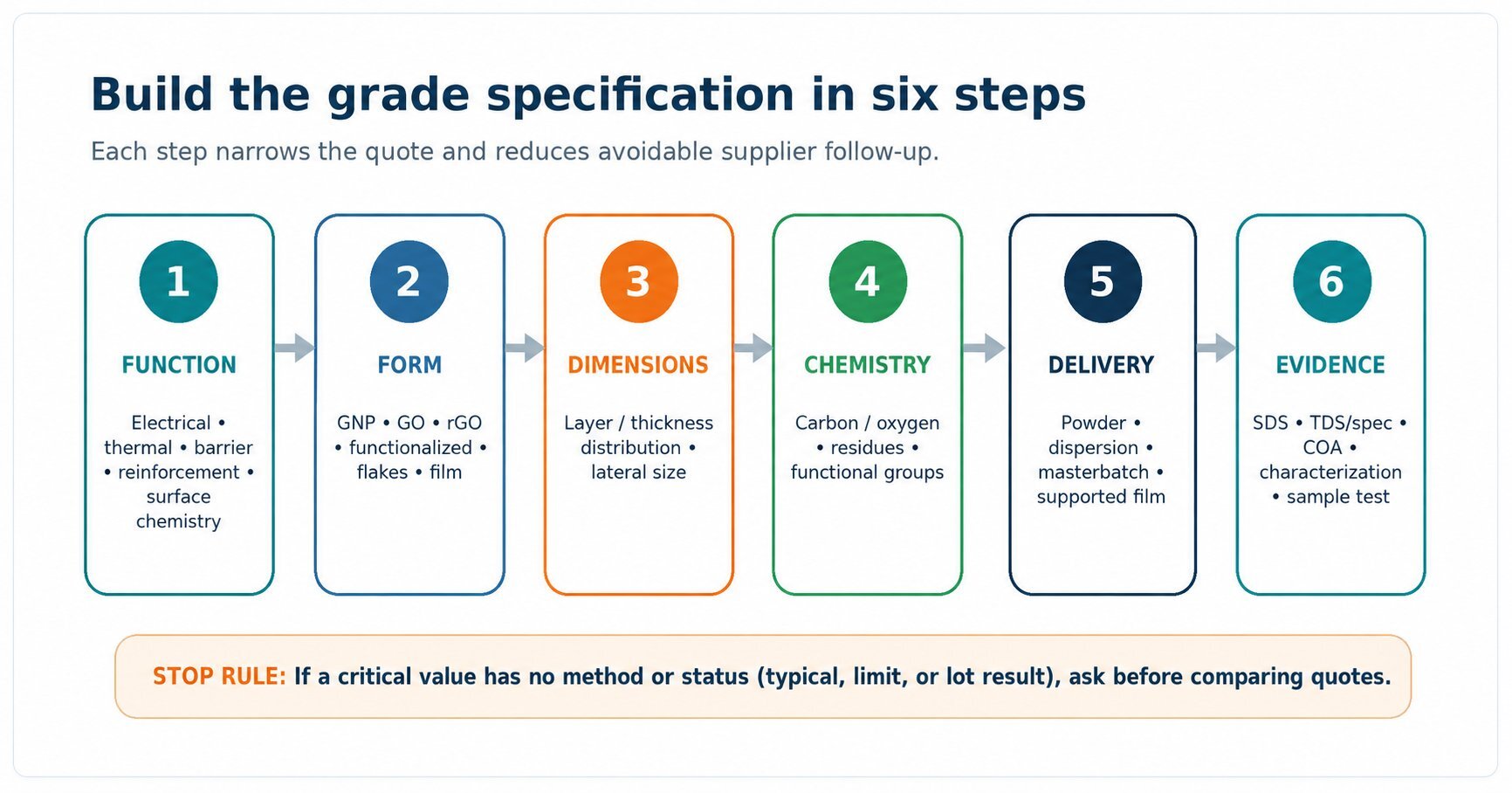
A higher purity number is not necessarily always a better grade. When it comes to a composite or coating, the formation of a network, the lateral size, the bulk density and the dispersion will matter more than the touted carbon percentage itself. For GO or functionalised graphene, the oxygen content, the surface chemistry and the dispersion medium itself may determine the compatibility of the process. In the case of research requiring sensitivity to layers, both the distribution of the layers and the method used for their characterisation are crucially important.
Start with the application bottleneck
- Conductive or thermal networks
- Barriers or reinforcements
- Surface chemistry compatible with water
- Layer-defined electronic or optical properties
- Substrate coverage or film transfer
Do not start with a superlative
- ‘Highest purity’ without method
- ‘Single layer’ without distribution
- ‘Best conductivity’ without test form
- ‘Industrial grade’ without limits
- ‘Same material’ over powder, dispersion and film
PURITY ALONE IS NOT A GRADE: Two materials that have very close carbon contents may be different in terms of layer distribution, lateral size, presence of defects, oxidation, surface area, bulk density, functionalization, and dispersibility itself.
3. Send a Complete RFQ Instead Of Asking For “Graphene”
A complete request for quotation will allow your supplier to establish the closest available grade, reveal where the request falls outside the standard range - and then quote you on the right packaging, documentation and lead time itself. The checklist below has been developed for research workers, formulators, laboratory managers and procurement teams.
| RFQ field | What to include | Why it matters |
|---|---|---|
| 1. Application and measurable target | State what the material has to alter: electrical, thermal, barrier, reinforcement, optical or surface behaviour. | Suppliers can't select a grade based on an industry name alone. |
| 2. Matrix, substrate and process | Specify the polymer, solvent, binder, substrate, pH range, mixing method or any other pertinent process constraint. | Graphene itself will behave quite differently in various systems. |
| 3. Material family | GNP, GO, rGO, functionally modified graphene, layer-controlled flakes or a supported film. | This stops materials that are nothing alike from being described as equivalent materials. |
| 4. Delivery format | Powder, dispersion in water or solvent, masterbatch, paste or film supported. | Delivery form affects both handling and development work as well as shipping itself. |
| 5. Layer or thickness target | Specify your target range and ask how this is determined. When the application is very sensitive, also request a distribution. | One single average won't reveal the entire material population itself. |
| 6. Lateral size distribution | State which range is significant to your process and ask about the measurement method used. | Your lateral size impacts the formation of networks, viscosity, coverage, and reinforcement itself. |
| 7. Chemistry and residual limits | Carbon or purity basis, oxygen or C/O, ash, remaining catalyst, acid or those residues critical to you. | Its useful limits depend entirely upon your application and also your test method itself. |
| 8. Surface area and bulk density | Ask about these when dosing, wetting, packing, or having an accessible surface area are key issues. | They'll impact formulation and handling themselves - but don't replace information about the size or number of layers themselves either. |
| 9. Functionalization | Identify the desired product group or your performance objective and then ask what base grade was used and present any relevant treatment details. | Materials with functions shouldn't just be compared with the group name itself. |
| 10. Dispersion details | Medium, concentration, stabilizer or surfactant, on a solid basis, pH, and any necessary storage requirements yourself. | A dispersion represents a formulation itself - it's more than just some graphene mixed into a liquid itself. |
| 11. Quantity, packaging, destination and timing | Separate out the different quantities - sample, pilot scale and bulk ones; say what packaging preference you have, where they should be sent to and by when they are needed. | All these factors determine the scope of your quote, the shipping arrangements and your continuity plans themselves. |
| 12. Documents and validation plan | Request your current safety data sheet (SDS), technical data sheet (TDS)/ specification sheet, certificate of analysis (COA), process information, and any supporting characterization data, plus details of your acceptance test for the sample. | Documentation will actually make things more comparable, while application testing determines the final grade itself. |
RFQ example
Application: Conductive epoxy composite material.
Material shortlist: Graphene nanoplatelet powder or a process-compatible dispersion itself.
Critical information needed: The thickness or layer distribution, lateral size distribution, carbon and oxygen content, specific surface area and bulk density - please provide this along with your test methods.
Quantity: A 100-gram laboratory sample would be greatly appreciated - if you could also quote a 1-kg pilot batch that would be fantastic too.
Documents: Your latest SDS, TDS or specification sheet, some representative characterisation data and details about your lot COA process would all be really useful.
Destination and timing: We need it in [city/country] by [date].
Could you kindly inform us of your available pack sizes, lead times and any differences there might be between your sample grade and bulk product?
RFQ readiness score
| 0–39 | 40–69 | 70–89 | 90–100 |
|---|---|---|---|
| Incomplete | Follow-up needed | Comparison-ready | Procurement-ready |
LIMITATION: The score determines the completeness of the RFQ. It doesn't check on the technical suitability, supplier quality, or application performance itself.
4. Ask For The Document Stack That Matches The Buying Stage
Safety, technical, quality and characterisation documents aren't interchangeable. Be sure to ask for the precise product identifier and revision date itself - and ensure your supplier will explain if that number represents a typical value, a specification limit or a result for the actual shipped lot.
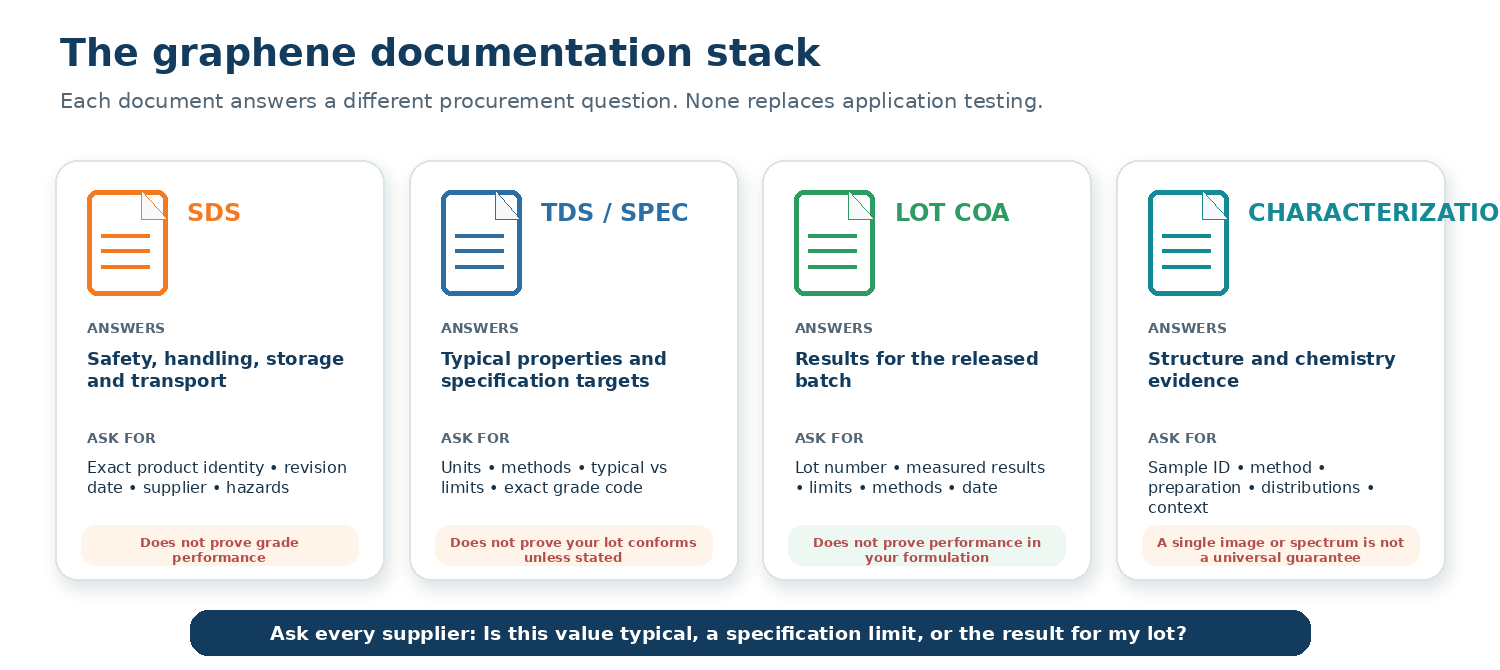
| Document | Best used for | What to request | What it does not prove |
|---|---|---|---|
| SDS | Hazards, handling, storage, exposure controls and transport information | Exact product identifier, supplier, revision date and current classification | Technical performance or lot conformity |
| TDS or specification sheet | Typical properties, target ranges or specification limits for the grade itself | Grade code, units, methods and whether each value is typical or a limit | That the shipped lot will meet all values - unless the document says otherwise |
| Certificate of Analysis (COA) | Results or release status for a particular lot | Lot number, measured results, limits, methods and release date | Performance within your process or end product |
| Characterization report | Evidence concerning structure and chemistry like layer/thickness, lateral size, disorder or oxidation | Sample identity, preparation, method, distributions, uncertainty and context | Universal guarantee or an application result |
Method context matters.
ISO/TS 21356-1 outlines a series of procedures for characterizing the structure of graphene from powders and dispersions themselves. ASTM E3220-25 deals with the measurement methods - including AFM, Raman spectroscopy and XPS - for matters like flake size, thickness, disorder and the carbon to oxygen ratio. Make use of method-sensitive supplier information so that your claims are directly comparable - do not consider a single image or spectrum as being entirely conclusive.
5. Compare Suppliers With The Same Scorecard
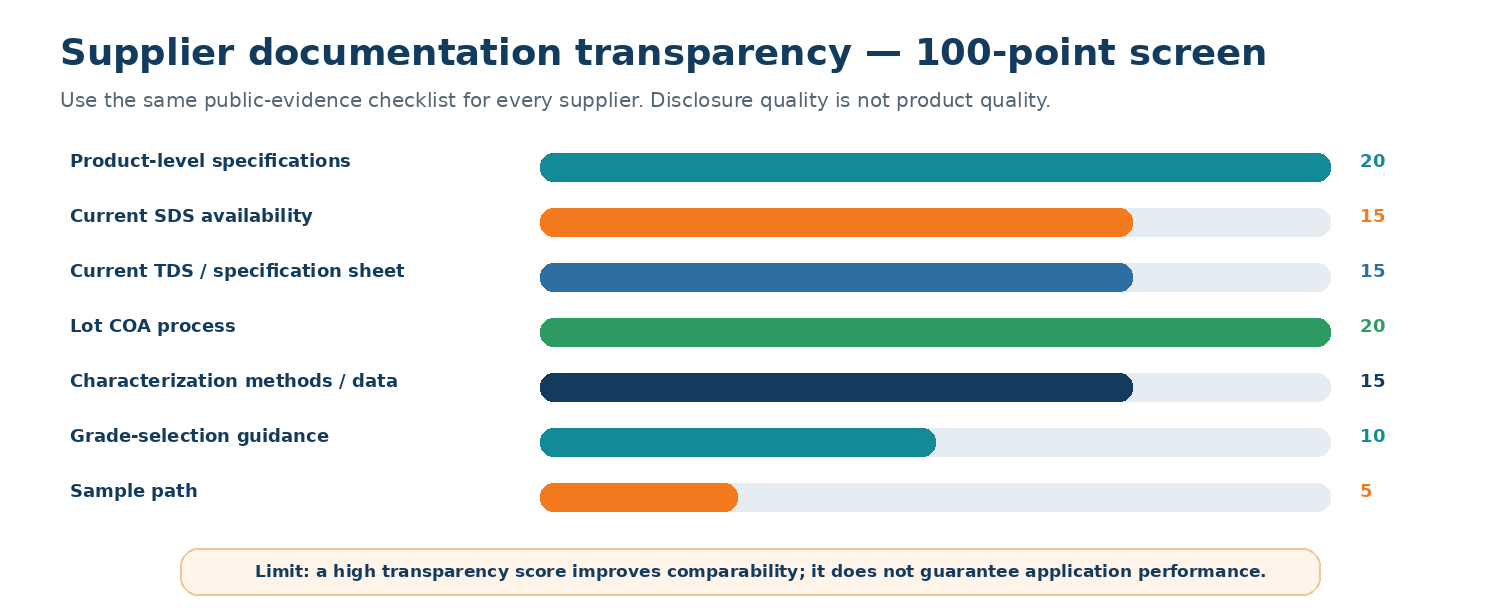
A consistent supplier screening will prevent a highly polished marketing webpage from being mistaken for a decision-ready product webpage. The following 100-point model assesses public documentation and purchasing support. It may be used on any supplier - including MKnano.
| Criterion | Points | What earns the points |
|---|---|---|
| Product-level specifications | 20 | The exact grade will have a really useful specification table that shows units and methods. |
| Current SDS availability | 15 | SDS is readily available, or the request path is quite obvious and very product-specific. |
| Current TDS / specification sheet | 15 | Typical values and limits are clearly separated within the document - there's even a revision date. |
| Lot COA process | 20 | The supplier explains exactly what results they report on the shipped lot itself. |
| Characterization evidence | 15 | They reveal relevant methods and sample identity too - not just some marketing images. |
| Grade-selection guidance | 10 | The supplier explains the differences between forms and grades themselves - without falling back on universal claims. |
| Sample path | 5 | A buyer can see how to ask for a representative sample before scaling up. |
IMPORTANT LIMITATION: Transparency in documentation really helps with being able to compare things and get ready for procurement. However, it won't necessarily show that one material is technically superior - or even that it'll pass your application test.
6. Understand What Changes The Quote
Do not compare the price per gram until all your suppliers quote the same type of product family, form, grade definition, quantity, and evidence package. A CVD film that is quoted by area, an aqueous GO dispersion, and a GNP powder represent completely different commercial products.
| Quote driver | Why it changes the comparison | What to ask |
|---|---|---|
| Material family and production route | GNP powder, GO dispersion, functionalized material and CVD film are not like-for-like products. | Ask what is included in the quoted material definition. |
| Layer, thickness and lateral-size target | Narrower or more demanding distributions may require additional production control and characterization. | Ask for the distribution, method and acceptance basis. |
| Oxidation, reduction and functionalization | Additional chemistry, purification or stabilization can change cost and minimum quantity. | Ask for the base material, treatment, residuals and documentation. |
| Purity and residual limits | A stricter limit only has procurement value when it is tied to a method and application need. | Do not pay for an unsupported percentage or an irrelevant limit. |
| Delivery format and concentration | A process-ready dispersion can reduce development work but includes medium, formulation and shipping variables. | Compare delivered solids, medium and pack format, not only price per container. |
| Quantity and packaging | Research vials, pilot packs and bulk containers have different unit economics and handling requirements. | Ask for sample, pilot and bulk tiers separately. |
| Documentation and custom testing | Lots of COAs, extra characterization or custom acceptance tests may add time and cost. | Define which evidence is essential before the quote is issued. |
| Destination and shipping classification | The exact powder or dispersion, solvent, and package can affect carrier options and landed cost. | Request the product-specific shipping classification and current SDS. |
7. Qualify The Same Grade From Sample To Repeat Supply
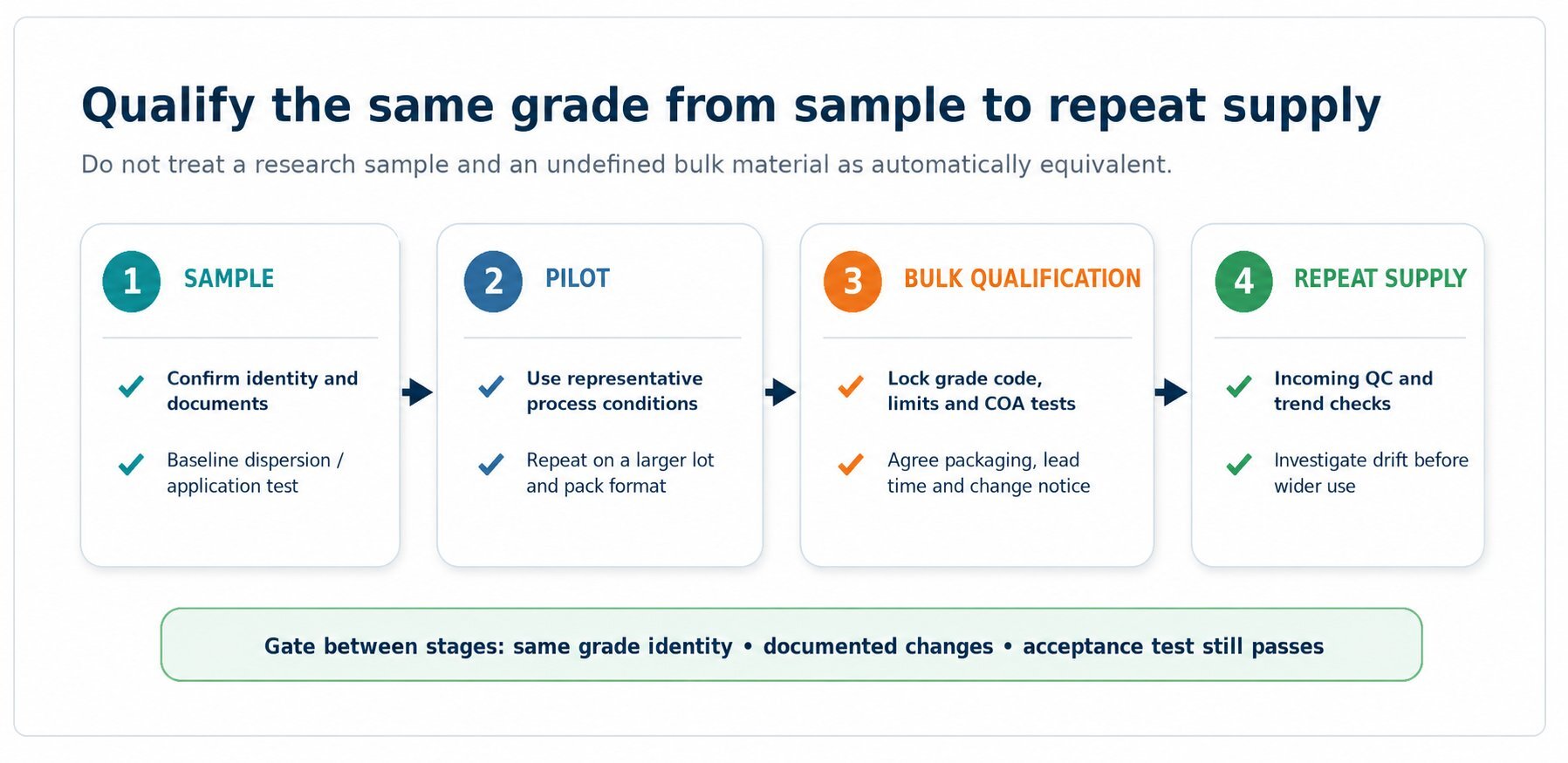
The purpose of a sample is really to decrease uncertainty itself - not to show that every subsequent batch will act identically. Create your acceptance test prior to receiving the sample, then perform it on a pilot scale and relate the bulk purchase specifications directly to the specific grade and COA procedure itself.
8. Check North American Documentation & Shipping Before Purchase
In U. S. workplaces, OSHA's hazard communication framework will use a standardized SDS structure. Requirements under Canadian WHMIS include having safety information in both official languages for hazardous workplace products. Obligations upon importation, processing, and transport may depend on the substance itself and its intended use - and solvent-based dispersions could even require an extra carrier. Be sure to check the current SDS, the product classification, the rules for the destination and your shipping method with suitably qualified EHS, logistics and regulatory staff members.
SAFETY AND COMPLIANCE NOTE: This article is your procurement starting point. It won't be replacing the current SDS (Safety Data Sheet), product label, workplace risk assessment, regulatory review, carrier decision, or application-specific validation right now. Don't assume powder or dispersion handling controls based on some general information in a blog post.
9. Use MKnano’s Graphene Hub & Product Pages In The Right Order
Make use of the spoke guide to prepare your RFQ. Use the hub and product pages to shortlist currently listed material families, then confirm the exact SKU, current specifications, documentation, pack sizes, quote scope and sample path.
View the current product-family structure.
Review listed platelet grades and request a technical quote.
Functionalized graphene in aqueous solution
Review currently listed functionalized routes.
Review the current GO solution listing.
Review the current product listing and request evidence for critical claims.
Contact MKnano technical sales
Send the RFQ, document request and destination details.
Frequently asked questions
Q. What should I include in a graphene RFQ?
A. Include the application, matrix or substrate, target function, graphene family, delivery form, critical layer or thickness and lateral size requirements, chemistry or residual limits, quantity, packaging, destination, necessary documentation and your planned sample test. Ask your supplier to specify the test methods used and whether the values given are typical, within the specification limits, or a result from a specific lot.
Q. Which form of graphene should I buy?
A. Select a form that will match the process. GNPs are very common starting points for bulk matrices and conductive or thermal networks themselves. GO or functionally modified dispersions could be better suited to work that is compatible with water or driven by an interface itself. Layer-controlled flakes or supported films will be more relevant if the distribution of layers, the optical properties, or the coverage of the substrate itself are paramount. Then validate your short list within the actual system itself.
Q. What is the difference between an SDS, TDS, and COA?
A. SDSs deal with hazards, handling, storage and transportation itself. TDS or specification sheets describe typical properties or limits for a given grade. A certificate of analysis (COA) will report results or release status for a particular batch. None of these documents individually confirm that the material will meet your application goal - a representative sample test is still essential.
Q. Is a high purity percentage enough to choose a graphene grade?
A. No. Purity is just one field, and its meaning really does depend on the method and basis being used. Layer or thickness distribution, lateral size, oxidation, defects, residuals, surface area, bulk density, functionalization and delivery format will be more important for a particular process itself. Be sure to ask for the full grade definition and the method used to determine those critical values.
Q. How can I evaluate a single-layer or few-layer claim?
A. Be sure to ask about layer or thickness distributions and the characterisation method itself - rather than just a marketing term. ISO and ASTM guidelines direct customers towards methods like AFM, Raman spectroscopy and XPS when trying to determine the structure and chemistry of a sample. The data should clearly state which sample it is, how it was prepared, and what method was used and will also need to tell apart single flakes from restacked dry material.
Q. Should I buy graphene powder or a dispersion?
A. Powder will give you a degree of flexibility and might also be cheaper to send - but it leaves the task of developing the dispersion and handling the powder to you, the customer. A dispersion can really speed up your development time if the medium, concentration and stabiliser are compatible with your process - but it could also create some problems when it comes to storing and transporting it. Have a look at the solid content, the carrier, the stability data and how well the product will work in your application.
Q. Can I request a sample before a bulk order?
A. A representative sample is generally the best initial step for almost all novel formulations. Ask yourself if the sample and bulk material employ the same grade code, specification, COA tests, and production route. Establish your acceptance test prior to the sample's arrival - then carry out this test at pilot scale once it has arrived - before finalising plans for your bulk supply.
Q. What should USA and Canada buyers check before shipment?
A. Request your current product-specific SDS and check on the destination's workplace, import and transport requirements. US SDSs are formatted in a standardized 16-section form. Canadian WHMIS requirements will include English and French safety information for those hazardous workplace products. Solvent-based dispersions might be subject to carrier-specific dangerous goods requirements themselves. Use experienced EHS, logistics and regulatory specialists for that particular material itself.
Prepare a graphene RFQ suppliers can answer
Share the application, process, preferred form, critical specifications, quantity, destination and documents needed. MKnano can then confirm which listed grades are available for evaluation and what current information can be supplied for the exact SKU.
Technical source notes
Supplier-listed specifications should be confirmed against the current product documentation before publication or purchase. Research findings and standards describe measurement approaches; they do not guarantee application performance.
- MKnano Graphene hub and listed product categories
- ISO/TS 80004-13:2024 — vocabulary for graphene and other 2D materials
- ISO/TS 21356-1:2021 — structural characterization of graphene from powders and dispersions
- ASTM E3220-25 — characterization of graphene flakes
- NPL Good Practice Guide 145 — characterisation of the structure of graphene
- OSHA Hazard Communication Appendix D — Safety Data Sheets
- CCOHS WHMIS / U.S. HCS variances
- U.S. EPA actions under TSCA Section 5
- Canada New Substances Notification 20405 — graphene
| Technical Notice: We provide general technical information, not application-specific engineering or safety advice. Results depend on product grade, materials, methods and operating conditions. Review the current SDS, TDS and product instructions, and independently test and confirm suitability before use. [Read the full Technical Information Disclaimer.] |