
Superparamagnetic vs Ferromagnetic Nanoparticles: Properties, Differences & Applications
Posted by MKnano (division of M K Impex Corp.) on 9th Nov 2026 | Nanoparticles
MKnano Magnetic Nanoparticle Selection Guide
Superparamagnetic vs Ferromagnetic Nanoparticles
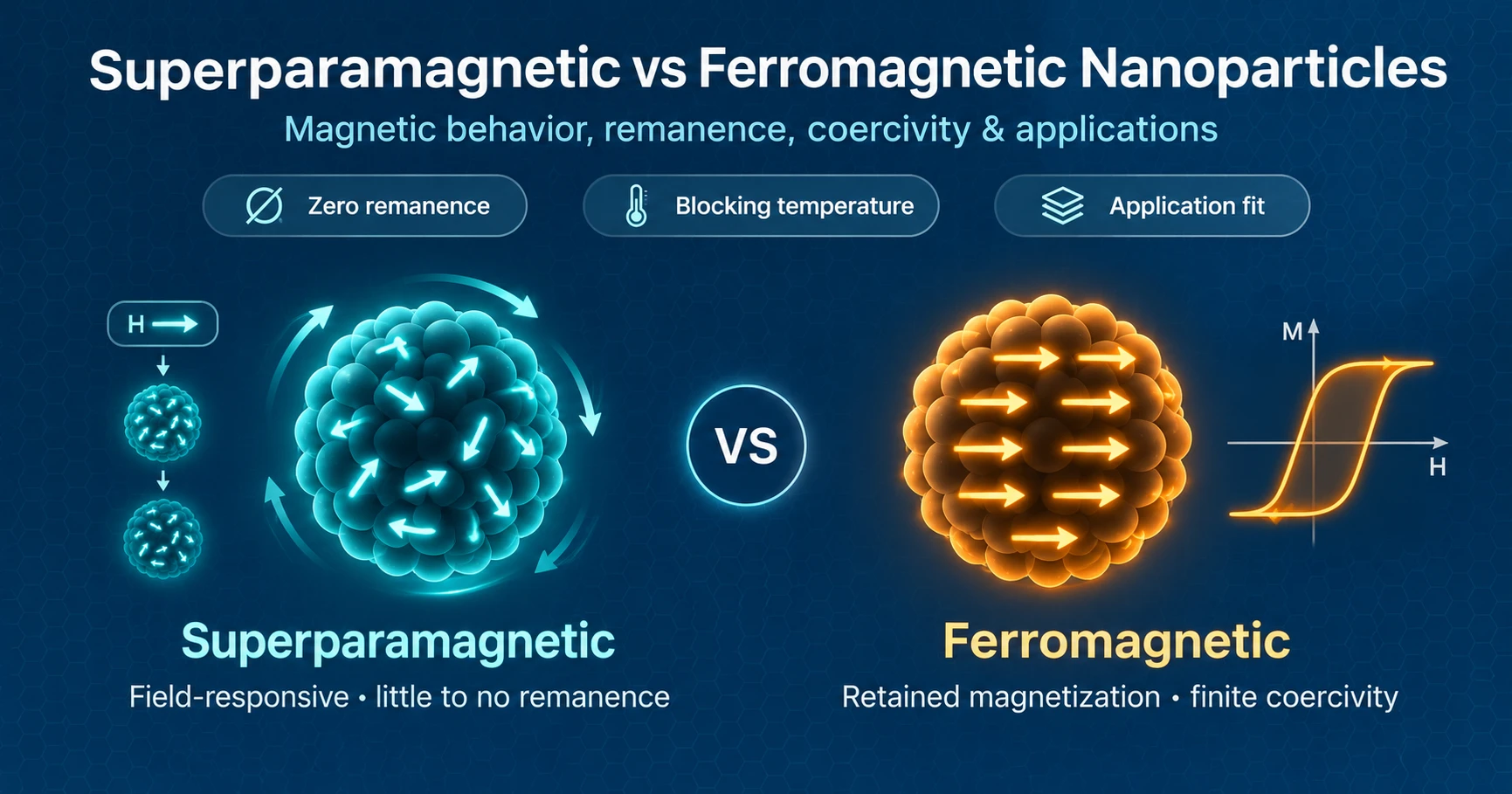
Both can respond strongly while a magnetic field is applied. The practical difference appears after the field is removed. In the superparamagnetic regime, measured remanence and coercivity approach zero under the relevant conditions. In a blocked ferro- or ferrimagnetic regime, finite remanence and coercivity can remain.
Explore the difference in three simple steps.
SUPERPARAMAGNETIC REGIME
Responds to the applied field
Illustration: particle moments align with the applied field.
A good field response can be obtained. A field response alone doesn't tell you whether the particles are superparamagnetic or blocked.
BLOCKED FERRO/FERRIMAGNETIC REGIME
Also responds to the applied field
Illustration: particle moments align with the applied field.
The useful distinction is therefore not simply “which one is attracted to a magnet?”
After the field is removed
Remanence, Mr: Approximately zero under qualifying conditions
Coercivity, Hc: Approximately zero
Hysteresis: Minimal/negligible in the ideal regime
After the field is removed
Remanence, Mr: Finite value may remain
Coercivity, Hc: Finite
Hysteresis: Measurable
Quick selection:
Evaluate superparamagnetic behaviour
assess superparamagnetic behaviour when low remanence following field removal is important.
Evaluate blocked ferro/ferrimagnetic behaviour
Assess blocked ferro/ferrimagnetic behaviour when retained magnetisation, coercivity or hysteresis is part of the required function.
Magnetic Nanoparticle Behavior & Grade Selector
Choose the options that best describe your project. The result highlights a starting pathway from the article; confirm the exact grade using current product data and testing.
1. After the field is removed
2. Supply format
3. Primary evaluation area
Result path A:
Start with superparamagnetic behavior
Use this route when the main requirement is low retained magnetisation. MKnano starting point: superparamagnetic iron oxide nanocrystals in a format of supply that is compatible with your process. Check Ms, Mr, Hc, measurement temperature, size distribution, coating, hydrodynamic size (for dispersions) and stability.
Result path B:
Start with blocked ferro/ferrimagnetic behavior
Use this pathway if you need retained magnetisation, finite coercivity and/or hysteresis. Start with ferrite nanopowder or another grade which has a documented Hc/Mr under the relevant conditions. Check Hc, Mr, Ms, phase, morphology and temperature stability and all test conditions.
Result path C:
Use dynamic magnetic characterization
For AC field- or frequency-dependent work static labels and static Ms/Mr/Hc are of no use at all. You have to look at field amplitude, frequency, relaxation, hysteresis losses, particle interactions, temperature, concentration and medium.
Superparamagnetic vs Ferromagnetic Nanoparticles at a Glance
| Selection factor | Superparamagnetic regime | Blocked ferro/ferrimagnetic regime |
|---|---|---|
| Field response | Can be strong | Can be strong |
| Remanence, Mr | Approximately zero under qualifying conditions | Finite value may remain |
| Coercivity, Hc | Approximately zero | Finite |
| Hysteresis | Minimal/negligible in the ideal regime | Measurable |
| Magnetic moment | Present but rapidly reversing relative to observation time | Relatively stable during observation |
| Best starting question | Do I need field response without persistent magnetization? | Do I need magnetic retention, switching or hysteresis? |
Why Can The Same Material Exhibit Such Different Magnetic Behavior?
A small enough ferro- or ferrimagnetic particle can be a single domain. It won't lose its moment in the superparamagnetic regime; thermal fluctuations are fast enough that the zero-field average of the moment will go to zero.
Superparamagnetic regime
Magnetic reversal is fast relative to the measurement time. Typical measurement: Mr ≈ 0 and Hc ≈ 0.
Blocked regime
The magnetic moment remains relatively stable during the measurement interval. Typical measurement: finite Mr and Hc; hysteresis may appear.
The observed state is a function of particle size and volume, composition, magnetic anisotropy, temperature, interparticle interactions, and timescale of measurement. A universal particle size cutoff cannot be applied to all magnetic materials.
What do Ms, Mr, Hc and Blocking Temperature tell you?
Ms — Saturation magnetization
How much magnetisation the sample will develop at sufficiently high applied fields.
Mr — Remanent magnetization
How much magnetisation remains when the field gets back to zero?
Hc — Coercivity
The reverse field required to bring the magnetisation back to zero after magnetisation.
TB — Blocking temperature
The measurement-dependent transition region between the blocked and the rapidly relaxing behaviour.
Which Magnetic Behaviour Is Appropriate For Different Applications?
| Application/research area | What to prioritize |
|---|---|
| Magnetic separation | Field response, low/controlled remanence, coating and hydrodynamic size |
| Ferrofluids & dispersions | Magnetic response plus solvent compatibility and colloidal stability |
| Magnetic sensing | Mechanism-specific Ms, Hc, anisotropy, size distribution and dynamic response |
| AC-field research | Relaxation, hysteresis, field amplitude, frequency and particle interactions |
| Storage/retention studies | Finite coercivity, remanence, anisotropy and thermal stability |
| Biomedical research | Exact grade, coating, stability and documented research status; research use does not establish medical approval |
Surface Chemistry and Supply Format Can Change the Practical Choice
| Process need | Starting format to evaluate | What to confirm |
|---|---|---|
| Aqueous processing or conjugation | Water-dispersible / functionalized iron oxide | Coating chemistry, charge, concentration, hydrodynamic size, stability |
| Organic-phase or polymer processing | Non-polar iron-oxide dispersion | Solvent, ligand, concentration, matrix compatibility, storage |
| Dry blending, ceramics or custom formulation | Dry iron-oxide or magnetic ferrite nanopowder | Composition, APS definition, phase, purity, magnetic data, dispersion plan |
Low remanence does not in itself prevent aggregation. Van der Waals attraction, surface chemistry, solvent compatibility, and concentration will all have an effect on the dispersion behaviour.
MKnano Magnetic Nanoparticle Selection Pathways
Superparamagnetic Iron Oxide Nanoparticles
Current forms are dry iron oxide nanocrystals, non-polar dispersions, water dispersible grades and surface functionalised forms. Use when the nanoscale iron oxide, the coating and the dispersion form are all relevant.
Current families are Co, Ni, Mn, Zn and the mixed ferrites. Used for composition property studies and grade-specific magnetic comparisons.
Before You Request a Quote: Define the Grade
Material & magnetic data
Format & documentation
Common Selection Mistakes
| Mistake | Better approach |
|---|---|
| Treating superparamagnetism as a permanent material label. | Assess the precise grade under the applicable temperature and test conditions. |
| Selecting by particle size alone. | Review composition, anisotropy, Ms, Mr, Hc, and the measurement conditions. |
| Assuming low remanence prevents aggregation. | Assess coating, solvent, hydrodynamic size and colloidal stability individually. |
| Comparing magnetization from unlike samples. | Compare on equivalent sample bases, units, coatings and test conditions. |
| Treating biomedical research as product approval | Confirm the exact product status, the documentation, the independent testing and the regulatory requirements. |
Frequently Asked Questions
What is the main difference between superparamagnetic and ferromagnetic nanoparticles?
Superparamagnetic particles show a magnetic response in an applied field but have essentially zero remanence and coercivity when measured in the superparamagnetic regime. Blocked ferro/ferrimagnetic particles can retain magnetisation and will exhibit hysteresis.
Are all small magnetic nanoparticles superparamagnetic?
No. Size matters, but composition, anisotropy, morphology, crystallinity, temperature, interactions and timescale of measurement all have an effect on the magnetic state.
What is blocking temperature?
It's the measurement-dependent transition region between the blocked behaviour and a regime in which the magnetic moment reversal is fast enough for the ensemble to appear superparamagnetic.
Why do Mr and Hc matter?
They indicate whether the magnetic history is retained after the field has changed or been removed. That's the key issue when deciding between low retention and retained magnetisation behaviour.
Can superparamagnetic nanoparticles still aggregate?
Yes. Low remanence will reduce the level of persistent magnetic attraction, though non-magnetic forces and poor surface compatibility can still lead to aggregation.
Are superparamagnetic iron oxide nanoparticles suitable for medical use?
They're extensively studied in the biomedical research literature but the research literature doesn't establish that every commercial grade is approved or appropriate for clinical, pharmaceutical, diagnostic or therapeutic use.
Selected Technical References
- NIST — Engineering and Optical Characterization of Magnetic Nanoparticles (MNPs)
- NRC Canada — Nanoscale Measurement
- Muthukumaran T, Philip J. A review on synthesis, capping and applications of superparamagnetic magnetic nanoparticles. Advances in Colloid and Interface Science. 2024;334:103314. DOI: 10.1016/j.cis.2024.103314.
- MKnano Magnetic Nanoparticles category
| Technical Notice: We provide general technical information, not application-specific engineering or safety advice. Results depend on product grade, materials, methods and operating conditions. Review the current SDS, TDS and product instructions, and independently test and confirm suitability before use. [Read the full Technical Information Disclaimer.] |